



LED Film Screen for Glass Window: A New Transparent Advertising Solution for Retail and Commercial Spaces
Product Name
led film screen for glass Window / Transparent LED Crystal Film Display
Display Type
Transparent LED Film / Led Crystal Film Screen / Flexible Glass Window LED Display
Typical Applications
- Retail store windows
- Shopping mall glass façades
- Automobile showrooms
- Jewelry store windows
- Commercial building glass
- Museums
- Exhibition halls
- Office lobbies
- Restaurants
- Brand flagship stores
- Escalator glass advertising
- Creative transparent installations
LEDLINO lists business-center showcases, automobile showrooms, window displays, museum exhibitions, concert stages, and jewelry-store windows among the main application scenarios for its crystal film product. 丽诺视界
Main Features
- High transparency
- Ultra-thin structure
- Lightweight installation
- Direct adhesion to glass
- Flexible and bendable design
- Suitable for curved glass
- Customizable size
- Seamless multi-panel splicing
- Wide viewing angle
- High refresh rate
- Wi-Fi and computer control options
- Dynamic video and animation playback
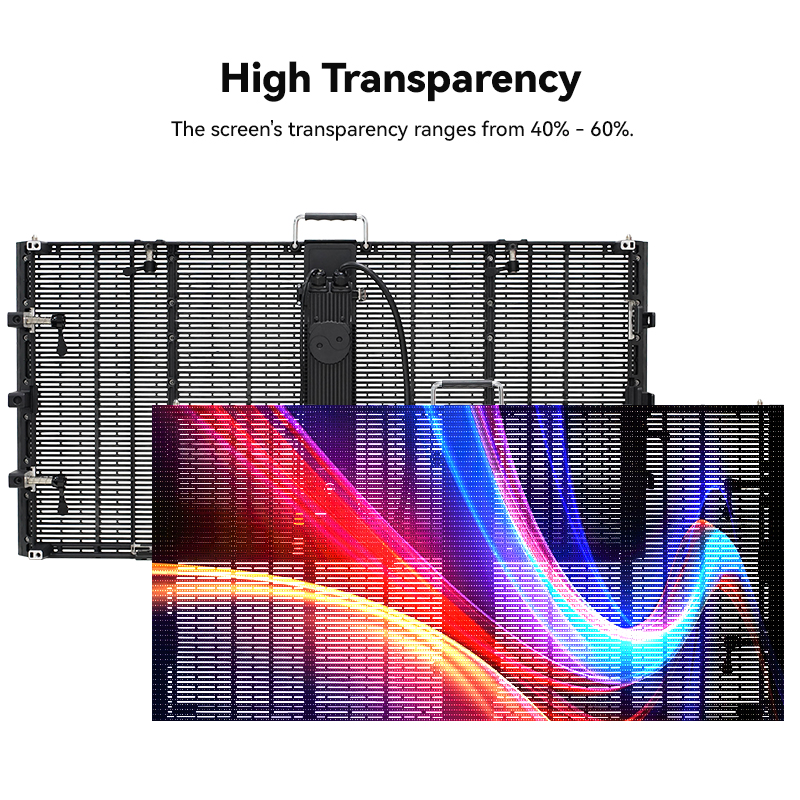
LEDLINO’s current crystal film screen is based on a high-temperature-resistant PET film structure. The company lists a thickness of about 3 mm, weight of ≤4.5 kg/m² on the technical table, transparency of roughly 85%–95% depending on model, a ≥3840Hz refresh rate, 16-bit grayscale, and 140° horizontal and vertical viewing angles.
News Content
led film screen for glass Window: Turning Glass Into Digital Media
Glass has always played an important role in retail and commercial architecture.
Storefronts use glass to show products. Shopping malls rely on glass façades to create open interiors. Car showrooms use large glass walls to connect indoor products with passing customers. Hotels, restaurants, museums, airports, and corporate buildings also use glass because it provides light, transparency, and a modern architectural appearance.
The problem begins when businesses want to add digital advertising.
A conventional led wall can deliver strong visuals, but it blocks the glass. LCD displays occupy physical space and interrupt the architectural design. Printed window graphics preserve simplicity but cannot show dynamic video.
An led film screen for glass window provides another option.
Instead of replacing the glass, the Transparent Led Film is installed directly onto or integrated with the glass surface. When operating, it can display videos, animations, logos, promotional content, and digital art. When content becomes dark or the display is turned off, much of the original glass transparency remains visible.
LEDLINO describes its crystal film screen as an ultra-thin transparent solution that can integrate closely with glass and preserve the openness of the architectural environment.
What Is an LED Film Screen for Glass?
An LED film screen is a thin transparent display that places LED light-emitting components on a flexible transparent substrate.
Unlike a conventional LED cabinet, which usually contains modules, metal cabinets, power supplies, receiving cards, and a solid rear structure, LED film technology minimizes the physical structure in front of the glass.
This makes the display appear significantly lighter and less intrusive.
LEDLINO’s LED crystal film product uses transparent PET-based material and allows the display to be adhered directly to glass. Its flexible construction can also adapt to certain curved surfaces.
The company’s dedicated LED film screen for glass page positions the technology for retail, hospitality, and corporate environments where businesses want dynamic digital content without replacing the underlying glass architecture.
Why Glass Window Advertising Needs Transparent LED Technology
A retail window has two functions.
It must communicate with customers outside the store, but it must also allow people to see the products and environment inside.
A conventional opaque screen forces a compromise.
If the screen covers the glass, digital content becomes visible but the store interior disappears. If no screen is installed, the glass stays open but the retailer loses a valuable digital media surface.
Transparent LED film combines these two functions.
Businesses can use the window for:
- Product advertising
- Brand storytelling
- Seasonal campaigns
- New product launches
- Pricing promotions
- Event information
- Dynamic graphics
- Digital art
while still maintaining a degree of transparency through the glass.
This makes transparent film especially attractive for premium retail and architectural projects where the window itself is part of the design.
Key Advantage 1: High Transparency
Transparency is one of the most important reasons to choose LED film.
LEDLINO’s current crystal film specifications show transparency levels ranging from approximately 85% to 95% depending on pixel pitch and configuration, with some higher-pitch products reaching the highest transparency values.
This allows natural light and background visibility to pass through the screen.
For retail stores, that means customers can still see:
- Products behind the window
- Interior lighting
- Store decoration
- Staff and customers
- Architectural details
while the LED surface displays moving digital content.
This is fundamentally different from installing a solid video wall behind the glass.
Key Advantage 2: Ultra-Thin Design
LEDLINO describes its crystal film screen as approximately 3 mm thick.
That ultra-thin structure is valuable when the project does not have enough space for a conventional LED cabinet.
In a shop window, for example, every centimeter of space matters.
A bulky screen can interfere with:
- Merchandise display
- Window decoration
- Customer sightlines
- Interior layout
An LED film display sits much closer to the glass, allowing the digital content to become part of the window rather than looking like a separate monitor installed behind it.
Key Advantage 3: Lightweight Construction
Traditional LED cabinets require structural support because the cabinet, power system, frame, and modules add significant weight.
Transparent film displays are much lighter.
LEDLINO’s published crystal film technical table lists screen weight at ≤4.5 kg/m², depending on configuration.
Lower weight can reduce the need for heavy steel structures and make installation more practical in existing retail environments.
This is particularly useful when the glass or building was not originally designed to support a conventional LED video wall.
Key Advantage 4: Direct Glass Installation
Installation is one of the strongest commercial advantages.
LEDLINO’s product instructions describe a process where the protective film is removed and the screen is adhered directly to the glass surface, with installation tools used to ensure close contact and reduce bubbles.
This can eliminate much of the structural complexity associated with traditional LED cabinets.
A typical installation process involves:
- Cleaning and preparing the glass.
- Positioning the LED film accurately.
- Removing the protective layer.
- Applying the screen to the glass.
- Removing trapped air or bubbles.
- Connecting the power and control system.
Because the glass itself becomes the installation surface, the final appearance can remain clean and minimal.
Key Advantage 5: Flexible and Curved Installation
Not every commercial window is flat.
Modern buildings increasingly use:
- Curved façades
- Cylindrical glass
- Rounded shop windows
- Irregular architectural surfaces
LEDLINO states that crystal film screens can bend and adapt to curved glass environments.
This gives designers more freedom than a rigid cabinet.
However, flexibility should not be confused with unlimited folding. LEDLINO specifically warns that the film must be bent gradually and should not be sharply folded because excessive bending can damage the internal circuit.
For curved architectural projects, the glass dimensions and curvature should therefore be reviewed before production.
Key Advantage 6: Custom Size and Cutting
LED crystal film is often marketed as cuttable, but this feature needs to be understood correctly.
LEDLINO’s technical article explains that the screen cannot simply be cut anywhere because power and signal circuits run through the film. If a circuit path is cut incorrectly, LEDs above that point may stop working.
The correct approach is to plan the final dimensions and circuit direction before installation.
LEDLINO lists standard film sizes such as 1000 × 240 mm, 1200 × 240 mm, and 1500 × 240 mm in its technical guidance.
This means custom shapes are possible, but the design should be engineered rather than cut randomly on site.
For architects and shop designers, this is an important distinction.
Key Advantage 7: Seamless Splicing
One film panel may not be large enough for an entire storefront.
Multiple film units can therefore be combined.
LEDLINO states that the thin and lightweight structure allows crystal film units to be closely arranged when spliced.
This makes the technology suitable for:
- Long storefront windows
- Large glass walls
- Shopping mall façades
- Exhibition walls
- Glass partitions
The screen size can grow according to the project rather than being restricted to a single conventional panel size.
Key Advantage 8: High Refresh Rate
Dynamic advertising must appear smooth both to the human eye and on cameras.
LEDLINO’s current crystal film product lists a refresh rate of ≥3840Hz.
This is valuable for commercial spaces because customers frequently photograph and film retail displays with smartphones.
A higher refresh rate can reduce visible camera banding or flicker and improve playback of:
- Product animation
- Fashion videos
- Fast-moving graphics
- Digital art
- Brand films
For social-media-driven retail campaigns, camera performance can contribute directly to the marketing value of the installation.
Key Advantage 9: Wide Viewing Angle
Retail windows are not viewed from only one position.
People approach from the left, right, front, and different walking distances.
LEDLINO lists a 140° horizontal and 140° vertical viewing angle for its crystal film screen.
This helps the display remain visible across a wider pedestrian area.
Wide viewing performance is particularly useful in:
- Shopping mall corridors
- Commercial streets
- Airport terminals
- Large car showrooms
- Exhibition halls
where visitor movement is unpredictable.
Key Advantage 10: Flexible Content Control
The value of digital advertising depends heavily on how easily content can change.
LEDLINO’s crystal film screen supports different control approaches, including synchronous computer control and asynchronous options using Wi-Fi-connected mobile devices or USB media depending on system configuration.
For a retailer, this allows one glass window to serve many campaigns.
Morning content can promote new arrivals.
Afternoon content can focus on a limited-time offer.
Weekend content can change to a brand event.
Seasonal campaigns can be replaced digitally instead of rebuilding the storefront.
LED Film Screen for Retail Windows
Retail is one of the strongest applications.
A fashion store can display moving models while physical garments remain visible behind the glass.
A cosmetics store can show product demonstrations.
A luxury brand can combine minimalist window merchandising with subtle floating digital graphics.
A restaurant can display menu promotions while customers still see the interior.
This is one of the main reasons LED film differs from conventional digital signage: it does not need to compete with the physical display behind the window. The digital layer and physical product can work together.
LED Film Screen for Car Showrooms
Car showrooms rely heavily on glass façades.
The glass creates openness and allows cars to remain visible from outside after business hours.
Installing opaque advertising panels would reduce that visibility.
LEDLINO lists automobile showrooms as one of its main crystal film screen application scenarios.
Transparent film can show:
- New model launches
- Vehicle specifications
- Brand videos
- Financing promotions
- Motion graphics
while the actual car remains visible behind the display.
This creates a combination of physical product presentation and digital storytelling.
LED Film Screen for Jewelry Stores
Jewelry windows need clean, premium aesthetics.
A bulky LED wall can overpower the merchandise.
Transparent film allows subtle moving content such as:
- Brand logos
- Product names
- Luxury animations
- Seasonal visuals
- Campaign graphics
while jewelry remains visible in the showcase.
LEDLINO specifically includes jewelry-store windows among its crystal film application scenarios.
LED Film Screen for Shopping Malls
Shopping malls contain large quantities of glass:
- Storefronts
- Escalators
- Atriums
- Railings
- Glass partitions
LEDLINO completed an indoor P4 crystal film project for escalator advertising, demonstrating how transparent film can turn normally unused glass into a digital advertising surface.
This type of installation allows mall operators to create media inventory without adding a bulky freestanding display that reduces walking space.
LED Film Screen for Museums and Exhibitions
Transparent displays can also support storytelling rather than direct advertising.
A museum can place digital information on glass in front of or beside a physical exhibit.
Visitors can see both layers simultaneously.
LEDLINO lists museum exhibitions among the primary use cases for its crystal film technology. 丽诺视界
This creates opportunities for:
- Object descriptions
- Historical animation
- Technical diagrams
- Digital reconstruction
- Interactive-style visual storytelling
Real LEDLINO Case: Indoor P4 Crystal Film Screen
LEDLINO recently completed an indoor P4 LED crystal film screen project using individual 240 × 600 mm units to create a customized total screen size of 3360 × 600 mm. 丽诺视界
The project was designed for applications such as glass-window advertising, retail display, showrooms, exhibitions, commercial signage, and transparent creative installations.
The case demonstrates several important advantages of the technology:
- Customized screen dimensions
- Lightweight structure
- High transparency
- Dynamic video playback
- Integration with glass
- Long horizontal advertising formats
Instead of installing a conventional heavy LED cabinet, the client could use a narrow glass-based digital surface that maintained the overall architectural openness. 丽诺视界
How to Choose Pixel Pitch for a Glass Window LED Film Screen
Pixel pitch affects image detail, transparency, viewing distance, and price.
LEDLINO’s current crystal film range includes multiple configurations such as:
- P4
- P5
- P4×8
- P6
- P8
- P10
- P10×20
- P10×30
- P10×40
- P10×60
In general, closer viewing favors smaller pitch.
Long-distance architectural advertising can use larger pitch while gaining greater transparency.
P4 / P5
Suitable for relatively close retail viewing and applications requiring more image detail.
P6 / P8
Useful for medium-distance mall, showroom, and commercial display applications.
P10 and Larger
Suitable for larger glass surfaces where viewers are farther away and transparency is more important.
LEDLINO’s published technical data shows the trade-off clearly: larger-pitch configurations can achieve higher transparency, including up to approximately 95% in suitable models. 丽诺视界
LED Film Screen vs Traditional Transparent LED Screen
Traditional transparent LED screens often use LED bars or cabinet frames.
LED film screens eliminate much of this mechanical structure.
Traditional Transparent LED Screen
- More rigid structure
- Often uses frames or cabinets
- Suitable for large architectural projects
- May provide stronger structural durability
LED Film Screen
- Ultra-thin
- Lightweight
- Directly attached to glass
- Flexible
- Better suited to existing windows
- Easier architectural integration
LEDLINO currently offers both conventional transparent screens and transparent LED film products, allowing the technology to be selected according to the actual project structure. 丽诺视界
LED Film Screen vs Holographic LED Screen
These terms are sometimes confused.
LEDLINO distinguishes between crystal film and holographic transparent displays.
Crystal film emphasizes:
- Thin construction
- Transparency
- Flexible glass attachment
- Custom size
- Simple installation
Holographic transparent screens focus more strongly on high-transparency floating-image-style visual effects and can use different structures and brightness specifications. 丽诺视界
The best choice depends on whether the project prioritizes glass integration, visual transparency, 3D-style impact, installation design, or viewing environment.
LED Film Screen vs LCD Window Display
LCD window displays can provide very fine resolution, but they remain physically opaque.
They block the area of glass directly behind the panel.
Transparent LED film provides a different experience because digital content can coexist with the physical environment.
Use LCD when:
- Very high close-up resolution is required
- Transparency is not important
- Standard screen sizes are acceptable
Use LED film when:
- Glass visibility matters
- The display must integrate with architecture
- Large custom dimensions are required
- The storefront should remain open and transparent
What Buyers Should Consider Before Ordering
Before purchasing an LED film screen for a glass window, buyers should confirm:
- Glass width and height
- Indoor or outdoor-facing installation
- Minimum viewing distance
- Desired pixel pitch
- Transparency requirement
- Required brightness
- Flat or curved glass
- Glass temperature and sunlight exposure
- Content type
- Screen dimensions
- Power supply location
- Control method
- Installation direction
- Destination country
- Project deadline
The glass itself should also be inspected to ensure it is clean, stable, and suitable for direct installation.
Important: Do Not Cut LED Film Randomly
This is one of the most useful practical lessons from LEDLINO’s technical content.
Although crystal film can be customized and trimmed, the circuit direction must be respected.
LEDLINO warns that random cuts across the internal conductive path can cause sections of LEDs to lose power permanently. 丽诺视界
For customized shapes, dimensions should therefore be planned with the supplier before production.
This is especially important for:
- Triangular windows
- Curved glass
- Cylindrical structures
- Irregular architectural shapes
Good engineering avoids wasted screen material and damaged circuits.
Why Supplier Experience Matters
LED film projects are closely connected to architecture.
The supplier needs to understand more than LED pixels.
The project may involve:
- Glass dimensions
- Adhesion method
- Power-box positioning
- Cable routing
- Film alignment
- Panel splicing
- Curved surfaces
- Custom cutting
- Content ratio
LEDLINO’s current portfolio includes transparent LED film, holographic transparent screens, conventional transparent displays, COB fine-pitch screens, outdoor displays, rental products, and customized LED solutions. The company also presents OEM/ODM, warranty, pre-sales, and after-sales support as part of its service offering. 丽诺视界
For retail contractors and architects, this broader product knowledge can help determine whether crystal film, holographic LED, or a conventional transparent screen is the better solution.
Why “LED Film Screen for Glass Window” Has Strong SEO Value
The keyword LED film screen for glass window combines a specific display technology with a clear installation scenario.
The searcher is usually not looking for general information about LED screens. They may already have a real glass-window project and are comparing:
- Manufacturers
- Pixel pitches
- Transparency
- Brightness
- Installation methods
- Price
- Custom sizes
Potential buyers include:
- Retail brands
- Shopping mall operators
- Architects
- Car dealerships
- Jewelry brands
- Exhibition contractors
- Advertising agencies
- Real estate developers
- AV integrators
- LED distributors
For an independent LED display website, this keyword can therefore attract visitors relatively close to supplier selection and quotation.
Conclusion
An LED film screen for glass window transforms a passive glass surface into a transparent digital media platform.
Instead of covering windows with opaque displays, businesses can use ultra-thin transparent LED film to show video, animation, promotions, brand stories, and creative visuals while maintaining natural light and interior visibility.
LEDLINO’s current crystal film technology combines direct glass installation, thin and lightweight construction, flexible design, approximately 85%–95% transparency depending on configuration, ≥3840Hz refresh rate, wide viewing angles, and multiple control methods
Its recent indoor P4 project also demonstrates how individual transparent film units can be customized into a 3360 × 600 mm display for glass-window advertising, retail, showroom, exhibition, and commercial signage applications.
For retail stores, malls, car showrooms, jewelry windows, museums, and modern commercial buildings, LED film offers a valuable combination of digital advertising and architectural transparency.
The best solution should be selected according to viewing distance, pixel pitch, transparency requirement, brightness, glass dimensions, content, and installation conditions—not simply by choosing the highest transparency or smallest pixel pitch.