




LED Video Wall for Conference Room: Why Fine-Pitch LED Is Redefining Business Meetings in 2026
led video wall for Conference Room: A Smarter Display Solution for Modern Collaboration
The modern conference room is no longer simply a place where employees gather around a table. It has become a central hub for business communication, strategic decision-making, remote collaboration, corporate presentations, and information sharing.
As organizations invest in digital workplaces, the demand for more capable conference room display systems continues to develop.
Traditional projectors, flat-panel televisions, and LCD video walls remain practical choices for many meeting spaces. However, businesses requiring larger display areas, seamless visuals, detailed presentation content, and flexible screen configurations are increasingly considering direct-view LED technology.
An led video wall for conference room applications offers a scalable display platform that can be configured to match different room sizes, viewing distances, and content requirements.
From compact executive boardrooms to large corporate meeting halls, fine-pitch led video walls help businesses communicate information through clearer visuals, continuous display surfaces, and flexible integration with modern audiovisual systems.
For architects, AV integrators, corporate buyers, and project contractors, understanding the capabilities of conference room LED displays is essential when planning a new meeting space or upgrading an existing one.
1. What Is an led video wall for a Conference Room?
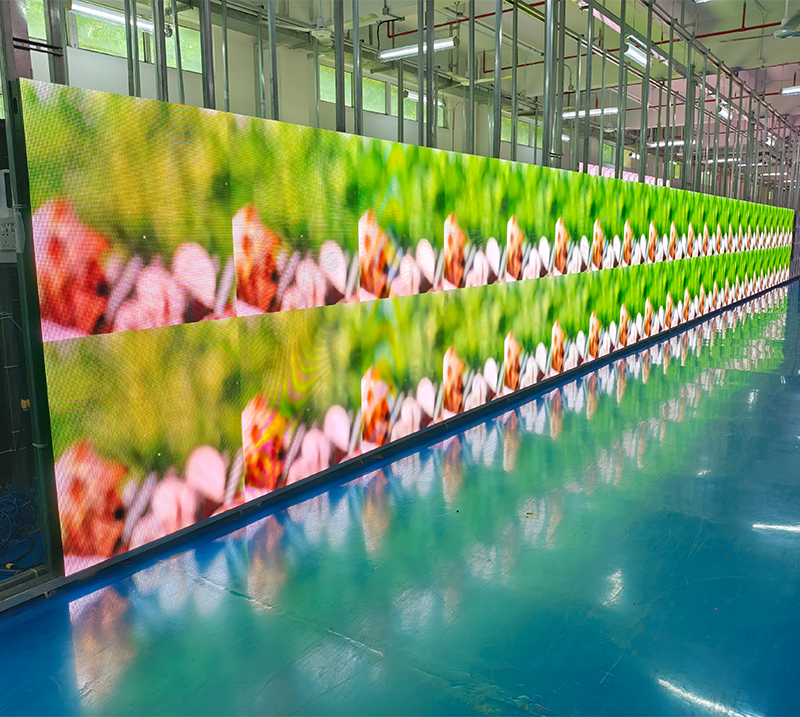
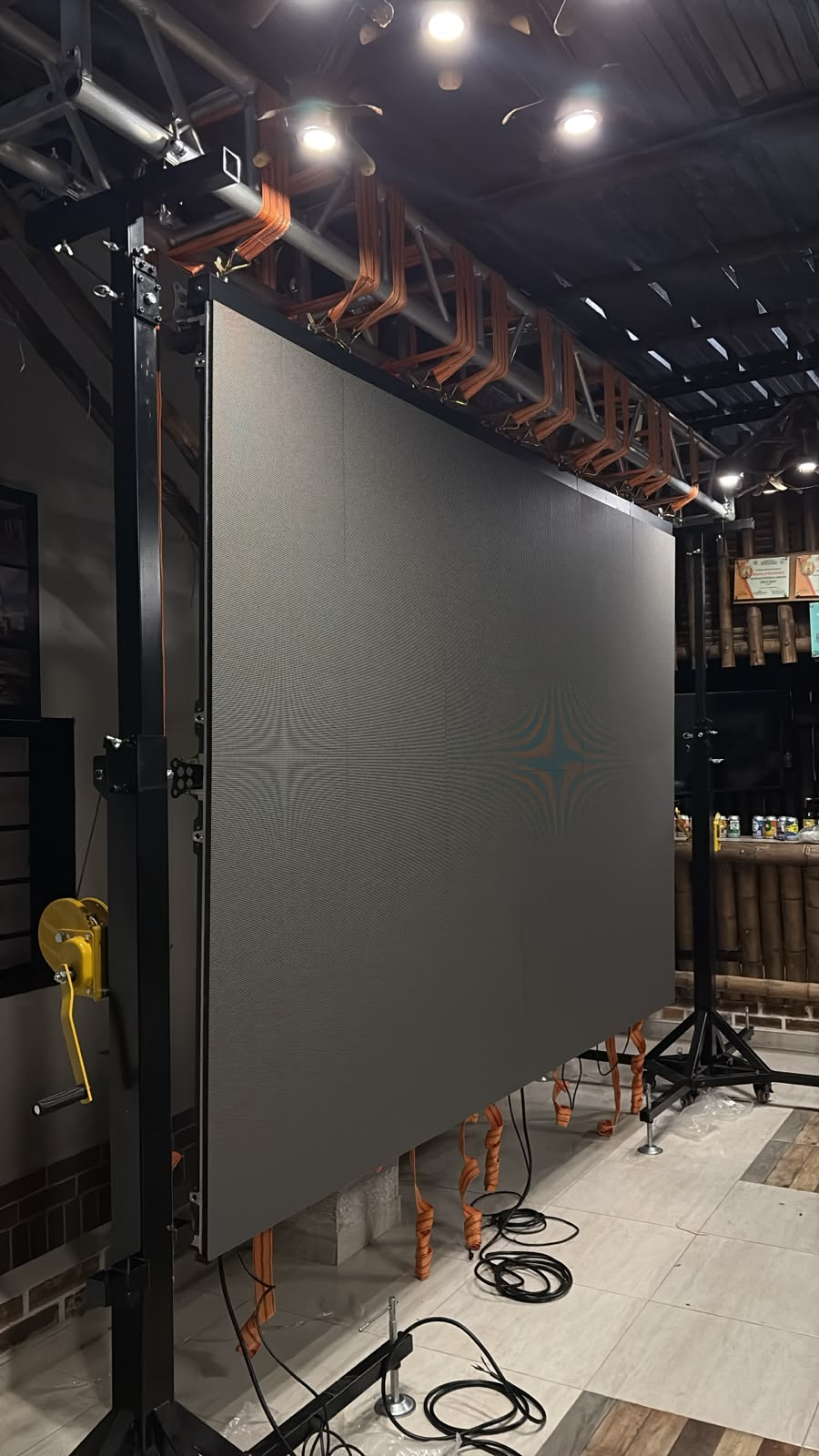
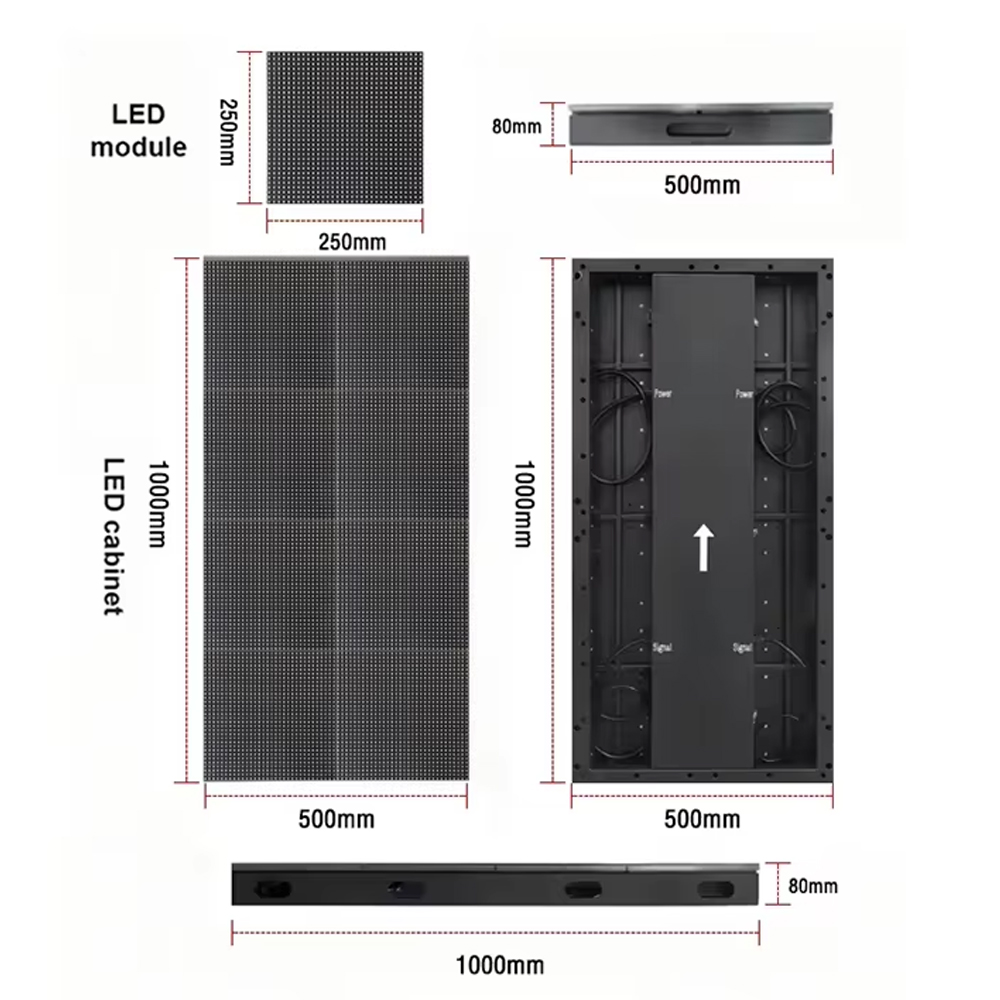
A conference room led video wall is a large-format display system assembled from multiple LED cabinets or modules to form a continuous digital screen.
Unlike an LCD video wall, which combines separate flat-panel displays, a direct-view led video wall uses light-emitting pixels across a modular display surface.
When correctly assembled and calibrated, the modules create a unified viewing area without the visible panel bezels associated with conventional LCD video walls.
Conference room LED displays can show various types of business content, including:
-
PowerPoint presentations and corporate reports
-
Video conferencing participants
-
Excel spreadsheets and financial dashboards
-
Business intelligence and data visualization
-
Product demonstrations and technical drawings
-
Training videos and educational materials
-
Live camera feeds and multimedia presentations
-
Corporate branding and promotional videos
A major advantage of modular LED technology is its flexibility.
Instead of choosing only from standard television sizes, customers can design an led video wall around the available wall space, preferred aspect ratio, viewing distance, and required resolution.
This makes LED displays especially attractive for conference rooms where both visual quality and architectural integration are important.
2. Why Are Businesses Choosing led video walls for Conference Rooms?
Seamless Visual Communication
One of the most important advantages of a conference room led video wall is its continuous display surface.
In meetings, important information may extend across the entire screen. Presentation slides, diagrams, charts, and dashboards often contain details that should remain clearly visible.
LCD video walls have physical borders between individual panels, even when narrow-bezel models are used.
A properly installed direct-view led video wall eliminates these panel borders, allowing content to extend across the display without interruption.
This is particularly valuable for executive presentations, financial reporting, product demonstrations, and multi-source visualization.
Improved Visibility Under Normal Office Lighting
Many conference rooms feature glass walls, large windows, ceiling lighting, and modern open-office designs.
Projection systems may require controlled lighting to maintain adequate image contrast, particularly when displaying detailed text or low-contrast content.
Direct-view LED displays generate their own light and typically provide greater brightness flexibility than conventional projection systems.
With appropriate brightness adjustment, the screen can remain clear while participants take notes, review documents, and interact with colleagues under normal room lighting.
However, brightness should be matched to the environment. Excessive brightness in a dark meeting room can be uncomfortable, so professional calibration remains important.
Clearer Business Presentations
Modern corporate meetings often involve detailed information rather than video alone.
Participants may need to read financial figures, engineering drawings, charts, maps, and multi-window presentation layouts.
Fine-pitch LED displays provide higher pixel density within a given screen area, supporting clearer text and finer visual details.
The actual image quality depends on pixel pitch, native resolution, screen dimensions, signal processing, content design, and viewing distance.
For presentation-heavy environments, these factors can be more important than simply purchasing the brightest or largest display.
More Flexible Screen Sizes
LED video walls are assembled from modular components, allowing the display to be configured for different room layouts.
For example, a corporate boardroom may prioritize a conventional 16:9 screen, while a larger presentation hall may require a wider display for simultaneous video feeds and presentation content.
Custom LED configurations can help designers use available wall space more effectively.
Final dimensions must still follow compatible cabinet and module sizes.
3. How Fine-Pitch LED Technology Improves Conference Room Displays
Pixel pitch is one of the most important specifications when selecting an LED display.
It refers to the distance between adjacent pixel centers, measured in millimeters.
A smaller pixel pitch allows more pixels to fit into the same physical screen area.
This is especially important in conference rooms because participants may sit relatively close to the display.
Common indoor pixel pitch options include P0.9, P1.25, P1.53, P1.86, P2, and P2.5.
Different configurations are suitable for different applications.
| Pixel Pitch | Typical Application |
|---|---|
| P0.9–P1.25 | Premium executive boardrooms and compact high-resolution displays |
| P1.53 | Corporate conference rooms requiring detailed presentations |
| P1.86 | Medium and larger meeting rooms with balanced clarity and cost |
| P2 | Training rooms and larger corporate presentation spaces |
| P2.5 | Larger halls with longer viewing distances |
These are general selection guidelines rather than fixed viewing-distance requirements.
The best configuration depends on the nearest seating position, screen dimensions, required native resolution, content detail, and project budget.
For instance, a small meeting room displaying spreadsheets may benefit from a finer pixel pitch than a large training hall primarily displaying video presentations.
Selecting an unnecessarily small pitch can also increase project cost without providing a meaningful improvement for viewers seated farther away.
Professional system design should therefore balance technical performance with actual meeting-room requirements.
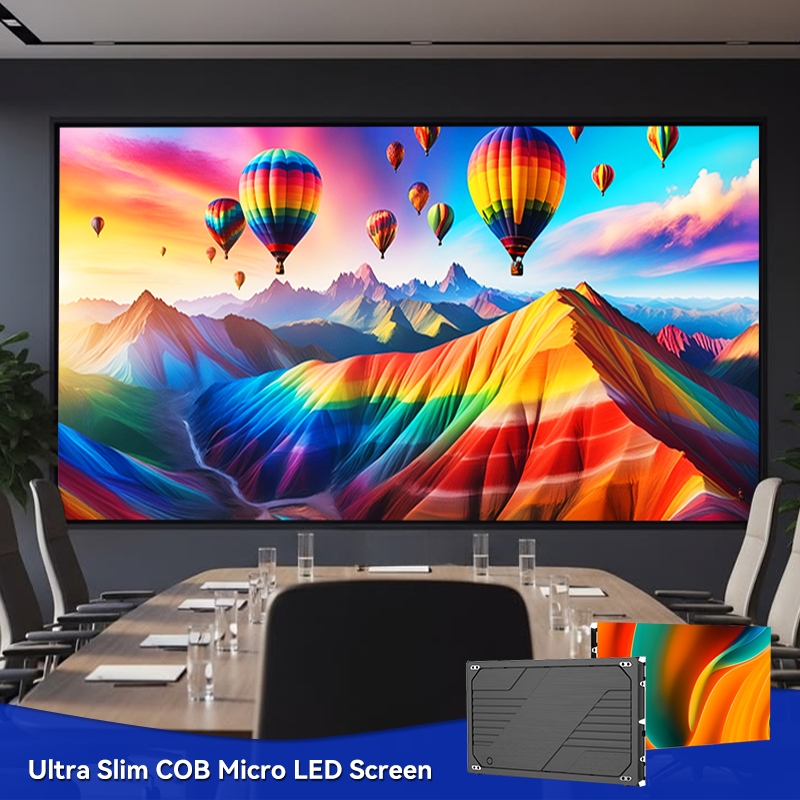
4. Why COB LED Displays Are Becoming Important for Premium Meeting Rooms
COB stands for Chip on Board.
In COB LED technology, LED chips are mounted directly onto a circuit board and protected with an integrated encapsulation layer.
This design differs from conventional SMD LED displays, where individually packaged LED devices are mounted onto the PCB.
COB technology offers several potential advantages for fine-pitch indoor installations.
Enhanced Surface Protection
Conference room displays may be installed in accessible areas where accidental touching, cleaning, and maintenance are common.
COB encapsulation provides a more protected surface compared with exposed conventional SMD components.
The actual level of protection depends on the module design and manufacturer specifications.
Fine-Pitch Capability
COB technology is particularly relevant to compact, high-pixel-density screens.
In executive boardrooms where viewers are close to the display, high pixel density helps improve fine-detail presentation.
This can be useful for technical drawings, spreadsheets, text-heavy reports, and multi-window business applications.
Visual Consistency
A well-designed COB LED video wall can deliver strong contrast, uniform image performance, and a smooth viewing surface.
These characteristics are valuable for premium meeting spaces where display quality contributes to the professional environment.
COB vs SMD vs GOB
Not every conference room requires COB technology.
SMD LED remains a mature and cost-effective choice for many commercial installations.
GOB technology adds a protective layer over certain SMD display modules, improving surface protection.
COB is often considered for premium fine-pitch and close-viewing applications.
The final technology choice should depend on performance requirements, maintenance planning, project budget, and the preferred pixel pitch.
5. Is a 4K LED Video Wall Necessary for a Conference Room?
4K resolution is becoming an important consideration in professional conference room design.
A native 4K UHD display contains 3840 × 2160 pixels, providing four times the pixel count of a standard 1920 × 1080 Full HD display.
However, a large LED video wall does not automatically provide 4K resolution.
The native resolution depends on the physical screen dimensions and pixel pitch.
For example, the theoretical active display dimensions required for a 3840 × 2160 LED wall are:
| Pixel Pitch | Approximate 4K Active Width | Approximate 4K Active Height |
|---|---|---|
| P1.25 | 4.80 m | 2.70 m |
| P1.5 | 5.76 m | 3.24 m |
| P1.86 | 7.14 m | 4.02 m |
These dimensions are mathematical examples. Actual buildable screen dimensions and native pixel counts must be verified against the available module and cabinet configurations.
This relationship explains why a compact 4K conference room video wall usually requires a finer pixel pitch.
When 4K is correctly implemented, businesses can benefit from clearer graphics, detailed documents, and improved multi-window presentation capability.
Nevertheless, native Full HD or other resolutions may still be entirely appropriate for smaller budgets, simpler content, or longer viewing distances.
The goal should be to deliver useful image detail, rather than selecting a resolution based on marketing terminology alone.
6. LED Video Wall vs Projector vs LCD Video Wall
Different display technologies serve different meeting-room requirements.
Before making an investment, buyers should understand their practical differences.
| Feature | LED Video Wall | Projector | LCD Video Wall |
|---|---|---|---|
| Large display sizes | Highly scalable | Highly scalable | Scalable using multiple panels |
| Visible internal bezels | No LCD-style bezels | None | Usually present |
| Bright-room performance | Strong when correctly specified | Depends heavily on projector and ambient light | Generally strong |
| Close-viewing detail | Depends on pixel pitch | Depends on optical and source resolution | Depends on panel resolution |
| Installation | Requires specialist planning | Requires projection and screen planning | Requires mounting and panel alignment |
| Initial investment | Often higher | Varies widely | Often competitive |
| Maintenance | Modular servicing | Optical and equipment maintenance | Individual panel servicing |
| Custom dimensions | Flexible within module constraints | Flexible within optical limits | Limited by panel sizes |
LED Video Wall vs Projector
Projectors remain a practical option for many education and meeting-room applications, especially where budget or temporary installation is the main consideration.
However, some projection systems require greater lighting control and must account for throw distance, shadows, and optical alignment.
Direct-view LED systems remove the need for a projector light path and can provide strong image visibility in well-lit corporate environments.
They are particularly suitable when businesses want a permanently installed large-screen presentation system.
LED Video Wall vs LCD Video Wall
LCD video walls offer mature technology, established service processes, and competitive initial pricing in many applications.
Their primary limitation is the visible border between panels.
An LED video wall provides a continuous image surface without these internal panel bezels.
For premium boardrooms, corporate showrooms, and high-visibility executive environments, this uninterrupted image can be an important advantage.
However, LED systems require careful consideration of native resolution, calibration, electronics, energy consumption, and maintenance.
7. Supporting Hybrid Meetings and Video Conferencing
Hybrid collaboration is one of the most important use cases for conference room LED video walls.
In a typical hybrid meeting, participants may be located in different offices, cities, or countries.
A single session may involve live video feeds, shared documents, presentations, and real-time collaboration.
A large LED display can help teams organize this content across a shared visual workspace.
For example, one section of the screen may display remote participants while another shows a presentation or dashboard.
This arrangement can help participants follow discussions without constantly switching between sources.
However, an LED screen alone is not a complete video conferencing solution.
A fully functional system also requires compatible cameras, microphones, speakers, conferencing software, network infrastructure, and appropriate AV processing equipment.
When configured correctly, an LED video wall can work as the main display within a larger collaboration system.
Video Conferencing Integration
Conference room LED video walls may be integrated with compatible conferencing platforms and devices through suitable AV hardware.
For example, companies using Microsoft Teams Rooms, Zoom Rooms, or other enterprise conferencing systems can design their LED display as part of a complete meeting-room solution.
Compatibility, output resolution, signal formats, and system control requirements should be confirmed during project planning.
Multi-Source Display
Professional video processors can support different input sources and display layouts, depending on the selected model.
This is valuable when teams need to compare documents, review financial reports, or show multiple video streams simultaneously.
Camera-Friendly Performance
Meeting rooms frequently use cameras to record presentations or support hybrid events.
For such applications, refresh rate, scan behavior, processor settings, and camera shutter compatibility are important.
The complete LED system should be tested with the intended cameras to reduce visible flicker, banding, or moiré effects.
8. How to Choose the Best LED Video Wall for a Conference Room
A successful LED video wall project begins with understanding the physical environment and practical business requirements.
Step 1: Measure the Available Wall Space
The screen dimensions must match the available installation area.
Buyers should measure the usable wall width and height, ceiling clearance, adjacent equipment, and any architectural restrictions.
The installation plan must also account for mounting structures, electrical wiring, signal cables, ventilation, and service access.
Step 2: Identify the Closest Viewing Position
The nearest seating position is an important factor when determining pixel pitch.
Smaller pixel pitches generally provide smoother-looking images at closer distances.
However, purchasing the smallest available pitch is not always necessary.
The ideal configuration should deliver comfortable readability from the intended seating positions.
Step 3: Define the Required Content Resolution
Businesses should identify what will be displayed most frequently.
A boardroom used for spreadsheets, financial reporting, and technical presentations may need greater pixel density than a room primarily used for videos and general presentations.
The display should also match the available computer outputs, conferencing equipment, and content formats.
Step 4: Select the Appropriate LED Technology
COB, SMD, and GOB solutions each offer different advantages.
A premium executive meeting room may prioritize fine pitch and enhanced surface protection.
A larger presentation hall may prioritize screen size and cost efficiency.
Step 5: Evaluate Brightness and Color Performance
Brightness should be appropriate for the room's lighting conditions.
The display should support comfortable presentation under normal office lighting without excessive glare.
Buyers should also consider grayscale performance, contrast, color consistency, and calibration capabilities.
Step 6: Confirm Refresh Rate and Processing
Refresh rate is particularly important when the display will be filmed or photographed.
A high-refresh-rate configuration may provide better compatibility with certain camera applications, but actual performance must be verified through testing.
The display controller and video processor must also support the required native resolution, input formats, and window layouts.
Step 7: Consider Front Maintenance
In modern offices, LED video walls are frequently mounted directly against a wall or integrated into decorative structures.
Front-maintenance configurations allow supported components to be serviced from the viewing side, helping reduce the need for rear maintenance access.
This can simplify space planning and improve service convenience.
The exact service method and component accessibility should be confirmed for the selected product.
9. Conference Room LED Video Wall Installation: What Should Buyers Know?
Even a high-quality LED display cannot deliver its intended performance without proper installation.
A professional project generally follows several key stages.
Site Survey and Engineering Design
The project team evaluates wall dimensions, structural load requirements, viewing distances, electrical access, room lighting, and AV integration needs.
Mounting Structure Preparation
A suitable steel or aluminum support structure is installed according to the approved engineering design.
Frame alignment is critical because uneven mounting can affect screen flatness and module alignment.
Power and Signal Planning
Power supplies, data connections, receiving cards, and cable routes are arranged according to the manufacturer's specifications and applicable electrical requirements.
Proper power distribution, grounding, circuit protection, and thermal management are important for safe operation.
Cabinet and Module Installation
LED cabinets and modules are installed, aligned, and checked for consistent positioning.
System Configuration and Calibration
The controller, receiving cards, video processor, and display settings are configured.
Brightness, grayscale, and color consistency are then checked.
Final Performance Testing
The completed screen should be tested with real meeting content, including text, spreadsheets, presentation slides, video feeds, and conferencing equipment.
This process helps identify potential issues before the room enters regular operation.
10. LEDLINO Conference Room LED Display Installation Experience
Real installation cases provide valuable guidance for companies planning their own LED display projects.
LEDLINO, also known as Lino Visino, has published conference room installations demonstrating different fine-pitch LED configurations.
Case Study 1: P1.5 Fine-Pitch LED Display for a Professional Conference Room
In a published conference room installation, Lino Visino supplied an indoor P1.5 fine-pitch LED display for a professional meeting environment.
The wall-mounted display was designed for business reports, presentations, training, video content, and detailed information sharing.
Because viewers sit relatively close to the screen, fine-pitch clarity was an important requirement.
The installation demonstrates how P1.5 technology can create a clean, seamless viewing surface while supporting different types of corporate communication.
Read the project: Indoor P1.5 Conference Room LED Display Installation
Case Study 2: P1.86 COB Indoor LED Display for a Modern Conference Room
Another LEDLINO installation features a P1.86 COB indoor LED video wall designed for a modern conference and presentation room.
The project included structural preparation, screen installation, power and signal configuration, system testing, and final display verification.
The finished screen provides a seamless large-format visual surface suitable for presentations, training, corporate videos, and multimedia communication.
This project highlights the importance of considering both display technology and engineering execution.
Read the project: P1.86 COB Conference Room LED Display Installation
These examples demonstrate why screen selection should consider the complete project rather than pixel pitch alone.
11. How Much Does a Conference Room LED Video Wall Cost?
The price of a conference room LED video wall varies significantly depending on the chosen configuration.
There is no universal price per square meter that accurately represents every conference room LED project.
The main cost factors include:
Pixel Pitch
Smaller pixel pitches generally require greater pixel density and more complex manufacturing, often increasing display cost.
Screen Dimensions
Larger screens require more modules, cabinets, mounting hardware, and potentially more controller capacity.
Display Technology
COB, SMD, and GOB configurations have different manufacturing costs and service requirements.
Native Resolution
Achieving 4K resolution in a compact screen can require a very fine pixel pitch.
Control System
Video processors, controllers, input interfaces, and multi-window functionality can influence the overall system price.
Installation Requirements
Wall structure, electrical work, labor, decorative finishing, and cable routing should be included in the project budget.
Maintenance and Support
Spare modules, technical assistance, warranty conditions, and maintenance planning also influence long-term ownership costs.
When comparing quotations, buyers should evaluate the complete installed system rather than focusing only on the LED cabinet price.
A well-designed solution should balance image quality, purchasing cost, maintenance accessibility, and operational reliability.
For an accurate quotation, suppliers typically need the screen dimensions, preferred pixel pitch, installation location, and intended application.
12. Common Mistakes to Avoid When Buying a Conference Room LED Wall
Several purchasing mistakes can affect the final performance of an LED display project.
Choosing Pixel Pitch Based Only on Price
A lower-cost display may be unsuitable if viewers sit too close and need to read small text.
Assuming Every Large LED Wall Is 4K
Physical dimensions do not determine resolution by themselves.
Always confirm the native pixel count.
Ignoring Room Lighting
An LED display should be calibrated for comfortable viewing under typical room conditions.
Forgetting Video Conferencing Integration
The video wall must work with the complete AV system, including cameras, microphones, speakers, conferencing hardware, and control devices.
Overlooking Maintenance Access
A poorly planned installation can make future component replacement unnecessarily difficult.
Comparing Only the Initial Screen Cost
Long-term serviceability, power consumption, system reliability, and supplier support should also be considered.
By addressing these factors early, businesses can reduce unnecessary project risks and select a display system better suited to their daily operations.
13. Where Can Conference Room LED Video Walls Be Used?
LED video walls support a wide range of professional communication environments.
Executive Boardrooms
Premium fine-pitch LED displays can support strategy presentations, financial reports, executive video conferences, and customer meetings.
Corporate Conference Rooms
A seamless LED wall provides a central platform for presentations, reports, collaborative discussions, and internal communication.
Hybrid Meeting Rooms
Large-format displays can present remote participants and shared content within the same visual workspace.
Corporate Training Centers
LED video walls support instructional videos, product demonstrations, interactive learning materials, and presentations for larger audiences.
Government Meeting Rooms
Professional LED displays can be used for reports, policy presentations, multimedia communication, and public-sector meetings.
Financial and Business Presentation Centers
Fine-pitch LED systems can display detailed charts, market information, dashboards, and technical data.
Corporate Showrooms
The same display technology can also support branding, customer presentations, product demonstrations, and promotional content.
14. What Makes a Reliable Conference Room LED Video Wall Supplier?
Choosing the right supplier is an important part of delivering a successful project.
Buyers should evaluate more than product price.
A professional supplier should be able to explain the differences between display technologies, recommend appropriate pixel pitches, and support the selection of suitable screen dimensions.
Technical documentation should clearly identify product specifications, native resolution, maintenance methods, controller compatibility, and installation requirements.
Project experience is another valuable factor.
Manufacturers and suppliers with relevant conference room installation references can help buyers understand potential engineering challenges and practical system requirements.
LEDLINO offers indoor fine-pitch LED video wall products and customizable configurations for business and commercial applications.
Its published conference room projects demonstrate experience with fixed-installation P1.5 and COB P1.86 solutions.
For customers planning an LED conference room upgrade, project-specific technical consultation can help identify a suitable balance between display performance, budget, and installation requirements.
15. The Future of LED Video Walls in Smart Conference Rooms
Conference room display requirements will continue to evolve as businesses adopt more integrated collaboration systems.
A modern meeting room must increasingly accommodate live video communication, shared documents, data visualization, digital presentations, and flexible content layouts.
Fine-pitch LED technology is well positioned for meeting rooms that require large, seamless viewing areas and detailed image performance.
COB packaging continues to provide an important option for premium close-viewing installations, while mature SMD and GOB solutions remain relevant for many commercial applications.
Future conference room upgrades are also likely to place greater emphasis on system integration, simplified operation, energy management, serviceability, and compatibility with modern AV infrastructure.
The most valuable LED video wall will not necessarily be the largest or most expensive.
It will be the system that matches the way people actually communicate and collaborate in the space.
Frequently Asked Questions About Conference Room LED Video Walls
Q1: What is the best LED video wall for a conference room?
The best option depends on room size, viewing distance, presentation content, budget, and required resolution. P1.25, P1.53, and P1.86 fine-pitch LED displays are commonly considered for professional conference room applications.
Q2: Is an LED video wall better than a projector for meetings?
An LED video wall can offer advantages such as strong bright-room visibility, seamless modular construction, and freedom from projector throw-distance requirements. However, projectors can remain practical and cost-effective for certain meeting rooms.
Q3: What pixel pitch is recommended for a conference room?
Smaller conference rooms generally benefit from finer pixel pitches, while larger rooms may use wider pitches. The nearest viewing distance and required text clarity should guide the selection.
Q4: Can a conference room LED video wall display 4K content?
Yes. A suitably configured LED video wall can provide native 4K resolution or display scaled 4K input signals. Native 4K capability depends on the screen's physical pixel count and supporting processing equipment.
Q5: What is the difference between COB and SMD LED displays?
COB mounts LED chips directly onto the PCB with integrated protective encapsulation. Conventional SMD uses individually packaged LEDs. COB is particularly attractive for certain premium fine-pitch applications, while SMD remains a mature and cost-effective technology.
Q6: Can LED video walls work with Microsoft Teams or Zoom?
Yes, LED video walls can be incorporated into compatible conferencing systems through suitable AV interfaces and processing equipment. The required integration must be confirmed during system design.
Q7: Are conference room LED video walls customizable?
Yes. Modular LED video walls can be configured to suit different dimensions, resolutions, and architectural requirements, subject to available cabinet sizes and system limitations.
Q8: How can I get an accurate conference room LED wall quotation?
Provide the room dimensions, preferred screen size, nearest viewing distance, required resolution, installation location, and intended content. A supplier can then recommend an appropriate configuration and prepare a project-specific quotation.
Conclusion: Build a Better Conference Room with LEDLINO
A modern LED video wall for conference room applications is more than a large digital screen.
It is a professional display platform that can support business communication, hybrid collaboration, executive presentations, training, and multimedia information sharing.
By combining fine-pitch LED technology, flexible modular design, seamless viewing surfaces, and appropriate AV system integration, businesses can create conference rooms that are better equipped for modern communication requirements.
The key to a successful project is selecting the right pixel pitch, screen resolution, technology, installation structure, and control system.
LEDLINO provides indoor LED video wall solutions for conference rooms, boardrooms, training facilities, and commercial presentation environments.
Whether you require a compact fine-pitch display, a premium COB video wall, or a customized large-format conference screen, our team can help evaluate the technical requirements of your project.
Looking for a reliable conference room LED video wall manufacturer or supplier?
Contact LEDLINO to discuss your screen dimensions, pixel pitch, installation requirements, and project budget.